How a run goes through its phases#
In what order does a run do its work, what stops it, and how does one exit status tell a caller what happened to a list of many lines?
The problem#
A run builds a list on one target through several tools, in many processes, and each tool has exit statuses of its own. Some outcomes say that a build is broken, some that a precondition held the work back, some that a later rerun will do, and one run can end with all three. The caller reads one exit status, and has to know from it what to do next, without reading the log of every line.
How eb-pipeline handles it#
The phases, in order#
A run goes through preflight, licences, shard, sources, admission, build, caches and logs, in that order.
A phase whose table is absent, or has enabled = false, is not configured, and the run passes over it.
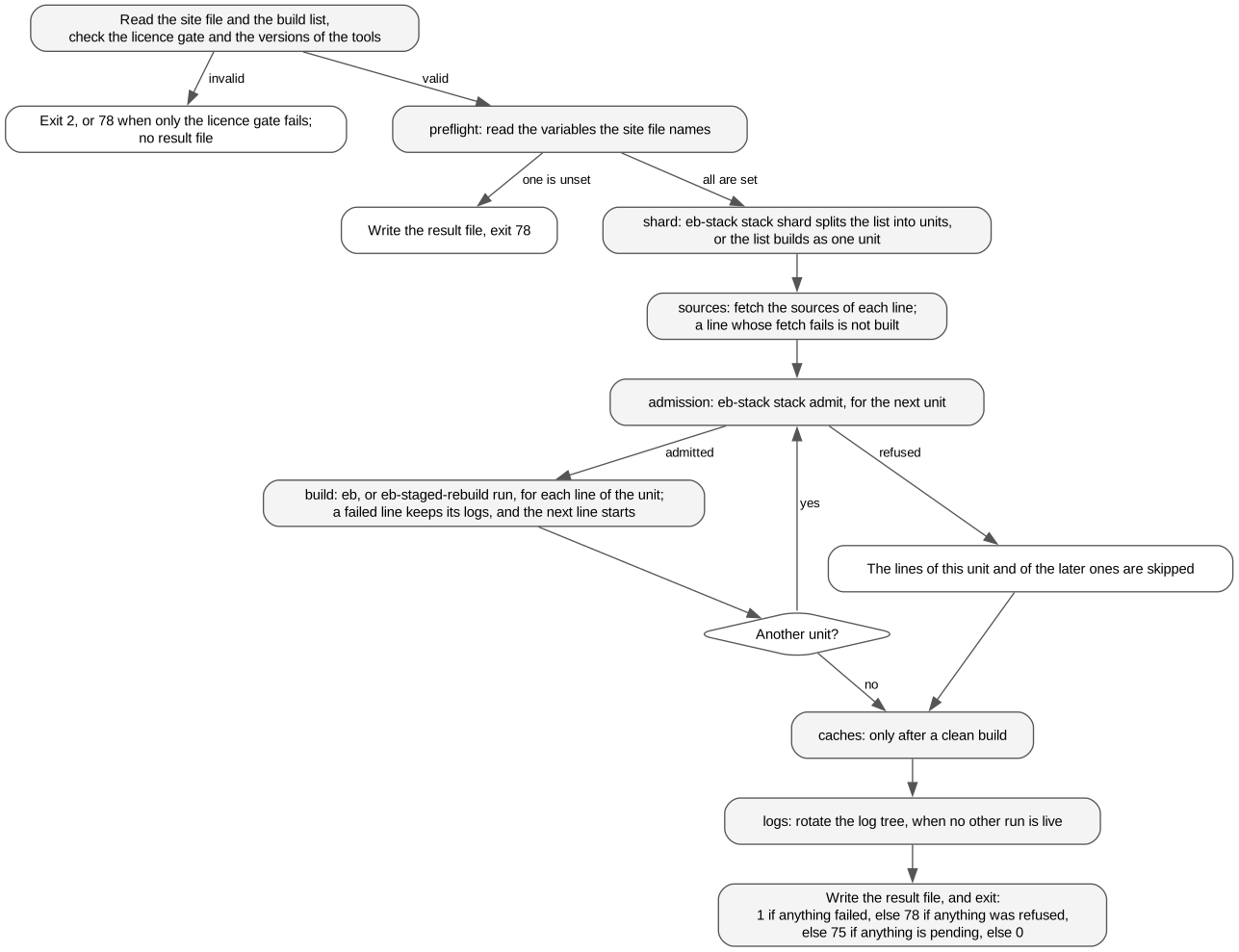
The phases of one run, and what each outcome does to the rest of it.#
Before the first phase, run reads the site file and the build list, and checks the licence gate and the versions of the tools.
An error there exits 2, or 78 when only the licence gate fails, and writes no result file, so the caller reads the exit status before the file.
The licences phase records the gate that passed.
preflightreads the variables that the site file names, such as the one that[admission]job_id_envnames; one that is unset, or a job id that is not a number, refuses the run, with exit 78.shardhaseb-stack stack shardsplit the list into units, or builds the list as one unit when the planner exits withshards.planner_exit_unsharded. Any other failure ends the run before the first build, with exit 1, or 2 whenstack shardexits 2.sourcesfetches the sources of each line; a line whose fetch fails isfailedand is not built, and the other lines go on.admissionandbuildtake one unit at a time. A refusal after the last attempt skips the lines of that unit and of every later one, and the run exits 78, or 1 when a line failed before; any other failure ofstack admitends the run at once.buildstarts the lines of a unit in list order. A line that fails keeps its logs, witheb-keep-logs failedwhen[logs]keep_failedis set, and the next line starts; so does the next line after a staged line that eb-staged-rebuild refused or left pending.cachesruns only after a clean build, andlogsrotates the log tree, as Why the rotation takes two locks describes.
Units, one at a time#
stack shard splits a list into units: the CPU-only prerequisites, when it lifts them out, then the prelude, which holds the modules that two or more shards need, then each shard.
run builds them in that order, one at a time, each after an admission of its own.
Each admission reserves the inodes of one unit, and the reservation is removed when the builds of that unit end, so a run holds the quota for the unit it builds, not for the whole list.
One exit status for the whole run#
A signal ends the run with its own status: run passes SIGTERM or SIGINT to the child that is running, starts no other, writes the result file, and exits 143 or 130.
Otherwise the run exits 1 when a line or a phase failed, else 78 when something was refused, by a precondition, by admission or by eb-staged-rebuild, else 75 when a step is pending, else 0.
The order puts first what needs the most from a person. A failed build needs someone to read its log, whatever else happened in the run; a refusal needs a precondition met or the quota freed, and the lines built before it stay built; a pending step needs only a rerun. The result file keeps what the status leaves out: the status of every line, with its log, and the counts.
The statuses of the tools, mapped#
The same number means different things to different tools: 2 is a usage error for eb-pipeline, and a refusal for eb-staged-rebuild run.
So run reads the status of each tool as that tool defines it, and records what it means:
eb-stack stack admitexits 0 when it admits, 78 when it refuses, whichrunretries with the backoff of[admission], 1 when it fails and 2 on a usage error.eb-stack stack shardexits withshards.planner_exit_unshardedwhen it built the plan unsharded, and the run goes on with one unit.eb-staged-rebuild runexits 2 for a refusal, which the line records asrefusedwithtranslated_from = 2, and 75 when a record that its ledger requires is pending.eb-keep-logs rotateexits 75 when another rotate holds its lock, and thelogsphase isskipped, with the status of the run as it was.
Any other status but 0 of these commands is a failure.
eb-keep-logs failed, which keeps the logs of a failed line, only logs a WARN when it fails.
What was considered and turned down#
An exit status that counts the failures. An exit status is one byte, and a count would run into the statuses that mean something else, such as 2, 75 and 78; the result file has the counts.
Passing the status of a tool through as the status of the run. The caller would read eb-staged-rebuild’s refusal, 2, as a usage error of eb-pipeline’s.
Building one shard alone. A shard can need what the prelude installs, so
runbuilds the units in order and has no option to build one of them.
Limits#
A run builds one unit at a time; two units of a list never build at once in one run.
A shard holds lines of the input list only, so a line whose other dependencies are not installed needs
--robotto build them.A job that the scheduler kills leaves its reservation behind, and
stack admitcounts it, unless[admission]live_jobs_cmdlists the jobs that still run.A signal ends the run only after the running child has ended.
Further reading#
Exit status, for the table of statuses.
The plan and result files, for the statuses of the lines and the phases.
Why one site file drives the build, for why the commands come from the site file.