
 eessi-arch-guard
Concepts
The EESSI module picks a CPU target once, at load time, and an accelerator target the same way. Both are written into MODULEPATH and into the paths later modules export. Slurm sends that environment to the job. A task that lands on another CPU or GPU then runs the submitting machine’s binaries.
module load EESSI/<version> inside the job leaves the record in place, because Lmod evaluates a loaded module file once. module reload, unload/load, and swap leave the other modules inactive. The sequence that changes the stack is: list LOADEDMODULES, module --force purge, module load EESSI/<version> by that full name, then load the other names in the same order.
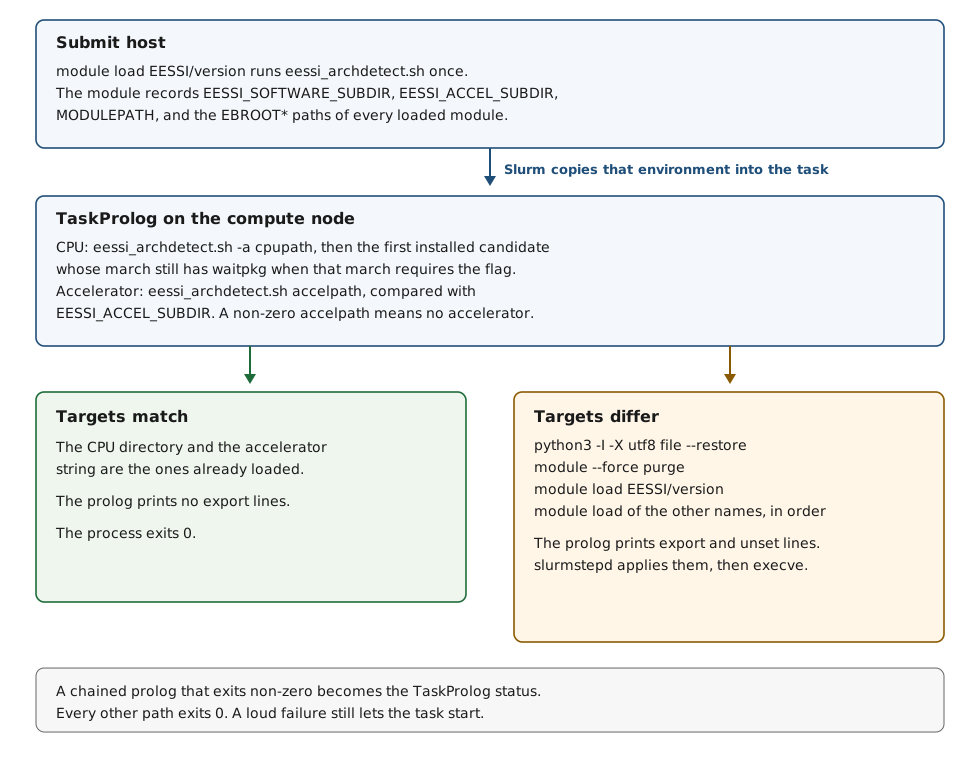
The prolog compares the loaded target with the node, then either returns or reloads.
The comparison is local to the task. CPU flags come from EESSI_PROC_CPUINFO or /proc/cpuinfo. The accelerator string comes from eessi_archdetect.sh accelpath, which sees the GPUs visible to the task. A job prolog runs outside the task cgroup, so a GPU hidden from the task is still visible there. The TaskProlog runs as the user, with the task environment, before execve.
On a mismatch the prolog runs a helper, python3 -I -X utf8 <this file> --restore, whose stdin is a JSON request carrying the task environment. The helper’s own process environment is PATH, HOME, LANG, LC_ALL, TMPDIR, and EESSI_ARCH_GUARD_WORKDIR. Module names are arguments to LMOD_CMD after a grammar check. Bash inside the helper is bash --noprofile --norc, with BASH_ENV, ENV, SHELLOPTS, BASHOPTS, BASH_XTRACEFD, and PS4 removed, and its last command is env -0. The prolog prints the delta of that environment: export and unset lines Slurm can apply, plus one print line for local task 0.
The detection topic is the CPU and accelerator walk. What the guard emits is the delta, the cache, and the deadline. Design records why this shape was kept.