
 eessi-arch-guard
Detection and matching
CPU selection stays inside eessi_archdetect.sh -a cpupath plus a directory walk. Subdirectory names come from that script’s stdout and from the directories that are mounted. An Intel node with A100 GPUs gets whichever candidate has a software directory, which is how open-001 was closed. Naming x86_64/intel/icelake or x86_64/intel/skylake_avx512 inside the program would pick the wrong tree on the other of those nodes, and on every AMD node.
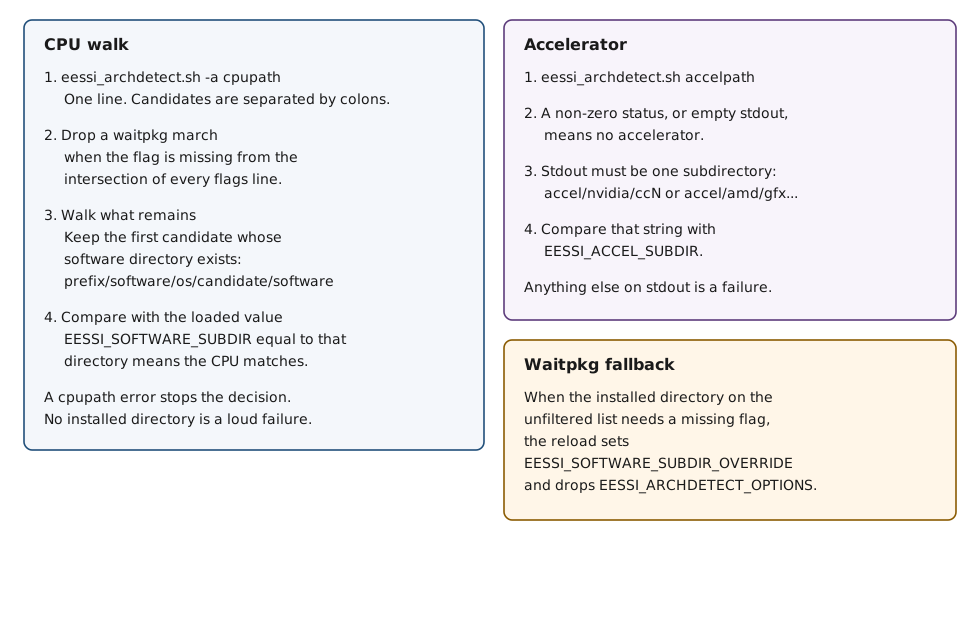
cpupath is filtered for waitpkg, then the first installed directory wins. accelpath is compared as a string.
The examples call the stub tests/stubs/eessi_archdetect.sh. It implements the argv contract the guard uses, [-a] cpupath or accelpath. The EESSI script is the one under EESSI_INIT_PREFIX on a real node.
Requirements before archdetect runs
EESSI_PREFIX and EESSI_INIT_PREFIX have to be absolute paths with no .. segment and no CR, LF, or NUL. EESSI_OS_TYPE has to be a relative subdirectory: no empty segment, no . or .., and each segment matching [A-Za-z0-9_.+-]+. A value that fails these checks is an archdetect failure, and the script is not started.
The script path is <EESSI_INIT_PREFIX>/eessi_archdetect.sh. It is run as bash --noprofile --norc.
CPU
cpupath must print one line, at most 65536 bytes, with no NUL and no character below ASCII 32. The line is split on :. Empty fields are dropped. Each candidate has to pass the same relative-subdirectory check.
The guard then reads CPU flags. The path is EESSI_PROC_CPUINFO when that variable is set, otherwise /proc/cpuinfo. Every flags line is parsed. The set used for the decision is the intersection: one logical CPU missing a flag removes it. The read stops at 16 MiB.
The waitpkg check
archdetect’s x86 spec requires the flags that separate one EESSI target from the previous one. GCC -march for that target enables a larger set. waitpkg (tpause, umwait, umonitor) is in the march mask and absent from the spec, so a virtual machine that hides the flag is still offered sapphirerapids. A binary built with that march then dies with SIGILL.
The guard drops a candidate whose leaf is one of these marches when waitpkg is missing from the intersection. The leaf spells - as _. The set is GCC 16 gcc/config/i386/i386.h on branch releases/gcc-16: the marches GCC 15.2.0 carried, plus novalake. znver6, the other new mask in that header, has no WAITPKG.
alderlake, arrowlake, arrowlake-s, clearwaterforest, diamondrapids, grandridge, graniterapids, graniterapids-d, novalake, pantherlake, sapphirerapids, sierraforest, tremont.
The other march flags stay unchecked. They are listed in CPU flags.
The installed directory
The walk keeps the first remaining candidate for which this path is a directory:
<EESSI_PREFIX>/software/<EESSI_OS_TYPE>/<candidate>/software
That directory is the CPU target. When no candidate has a directory, the result is ->no-software-dir unless EESSI_ARCH_GUARD_MISSING=ignore. See Correct a guard message.
archdetect’s own consumer, the EESSI module, walks the unfiltered list. When the directory that survives the waitpkg filter is further down the list than the directory the unfiltered walk would install, the reload sets EESSI_SOFTWARE_SUBDIR_OVERRIDE to the filtered directory and removes EESSI_ARCHDETECT_OPTIONS for that reload. A login-node value of EESSI_ARCHDETECT_OPTIONS would outrank the pin inside the module. The module’s archdetect wrapper then exports EESSI_ARCHDETECT_OPTIONS as that one subdirectory.
If the user already set EESSI_SOFTWARE_SUBDIR_OVERRIDE or EESSI_ARCHDETECT_OPTIONS_OVERRIDE, the guard skips detection entirely. The pin is the user’s.
Accelerator
eessi_archdetect.sh accelpath is compared as a raw string with EESSI_ACCEL_SUBDIR.
A non-zero status is “no accelerator”. Exit 2 (no
nvidia-smi) and exit 3 (nvidia-smifailed) are the EESSI script’s no-GPU paths. The EESSI wrapper stores that as an emptyEESSI_ACCEL_SUBDIR.Empty stdout on a zero status is “no accelerator”.
Stdout has to match
accel/nvidia/ccplus digits, oraccel/amd/gfxplus hexadecimal digits. Any other stdout, including a second line, is->archdetect-failed. An A100 isaccel/nvidia/cc80only when the script prints that string.
The ccNN to ccN0 directory fallback stays inside the EESSI module. The guard compares the string the script printed.
EESSI_ACCELERATOR_TARGET_OVERRIDE skips this comparison. The CPU walk still runs, and the loaded accelerator value is kept.
What a match is
The CPU target equals EESSI_SOFTWARE_SUBDIR, and, when the accelerator is being compared, the accelpath result equals EESSI_ACCEL_SUBDIR. Both sides empty counts as a match. The prolog then prints nothing.
When the accelerator differs, the reload label is <cpu> <accel> or <cpu> no accel on each side. The tutorial is the CPU-only case: zen4 loaded, zen2 detected, label x86_64/amd/zen4->x86_64/amd/zen2.
A GPU that changed
docs/examples/accelerator.py mismatch keeps the CPU at zen4, loads accel/nvidia/cc90, and points the stub nvidia-smi at compute capability 12.0. CUDA/12.6.0 exists on both accelerator trees, so the reload completes:
export EESSI_ACCEL_SUBDIR=accel/nvidia/cc120
export EESSI_ARCH_GUARD_RELOADED=x86_64/amd/zen4 accel/nvidia/cc90->x86_64/amd/zen4 accel/nvidia/cc120
print eessi-arch-guard: reloaded modules for x86_64/amd/zen4 accel/nvidia/cc120 (loaded for x86_64/amd/zen4 accel/nvidia/cc90)
MODULEPATH in that run gains the cc120 modules directory ahead of the zen4 CPU modules. The full transcript also rewrites PATH under $PREFIX.
When CUDA/12.6.0 exists only on cc90, the same node prints a failure and leaves the loaded accelerator in place:
$ python3 docs/examples/accelerator.py missing-module
export EESSI_ARCH_GUARD_FAILED=x86_64/amd/zen4 accel/nvidia/cc90->x86_64/amd/zen4 accel/nvidia/cc120
print eessi-arch-guard: this node is x86_64/amd/zen4 accel/nvidia/cc120, the modules were loaded for x86_64/amd/zen4 accel/nvidia/cc90; not available for this target: CUDA/12.6.0; environment left as it was
Load a CUDA build that exists for cc120, or drop CUDA/12.6.0 from the submitting environment.